
Engineering Materials Guide
POM vs Nylon: Melting Point and Thermal Stability Comparison
POM and nylon are both semi-crystalline engineering thermoplastics, but they behave very differently when temperature, moisture, mechanical load, and dimensional tolerance become critical. We compare their melting behavior, thermal stability, processing requirements, and practical use cases for precision plastic parts.
Our engineering summary: Nylon, particularly PA66 and heat-stabilized or glass-filled grades, normally provides the higher temperature capability. POM is often the better choice for moderate-temperature precision components that need low friction, low moisture absorption, and stable dimensions.
Quick Answer: Is POM or Nylon Better at High Temperatures?
For sustained high-temperature service, nylon is generally the stronger candidate. PA66 has a substantially higher melting point than POM, and heat-stabilized or glass-fiber-reinforced nylon can retain useful strength and stiffness under demanding thermal conditions. PA6 also exceeds POM in melting point, although its moisture response must be included in the design.
POM, also called acetal, remains highly valuable at moderate temperatures. It has very low moisture absorption, excellent dimensional stability, low friction, and predictable machining behavior. Those characteristics can make POM more reliable than nylon for precision gears, bushings, valve parts, and mechanisms exposed to humidity or washdown.
Choose nylon when
Heat exposure, impact, structural loading, or elevated-temperature creep resistance is the main concern.
Choose POM when
Low friction, tight tolerances, moisture resistance, and repeatable dimensions matter more than maximum heat capability.
The word “better” is therefore application-dependent. We evaluate continuous-use temperature, short-term heat spikes, mechanical load, moisture conditioning, reinforcement, chemical exposure, and the exact supplier grade before approving a material.
POM and Nylon at a Glance
POM is polyoxymethylene, commonly called acetal. Nylon is the common engineering name for polyamide, or PA. Both are semi-crystalline thermoplastics, which means they contain ordered crystalline regions that provide strength, wear resistance, and chemical performance, together with less ordered regions that influence toughness and processing.
The thermal comparison is not between two single materials. Relevant grades include POM homopolymer, POM copolymer, PA6, PA66, PA12, impact-modified nylon, heat-stabilized nylon, and glass-fiber-reinforced nylon. Resin grade, additives, fillers, pigments, molding history, and conditioning state can all change the values published on a technical data sheet.
POM family
POM homopolymer and POM copolymer are used for low-friction, dimensionally stable mechanisms.
Nylon family
PA6, PA66, and PA12 offer different balances of heat resistance, toughness, flexibility, and moisture uptake.
Modified grades
Glass fiber, heat stabilizers, lubricants, flame retardants, and impact modifiers change design behavior.
What Is POM (Polyoxymethylene/Acetal)?
POM is a semi-crystalline engineering thermoplastic known for low friction, good wear resistance, low moisture absorption, and precision-molding performance. It is widely used for gears, bushings, rollers, valve components, clips, latches, conveyor components, and sliding parts.
Its low water uptake is a major practical advantage. A machined or molded POM component usually changes less after exposure to humidity or water than a comparable nylon component. This helps us maintain fits and clearances in mechanisms where backlash, shaft alignment, or sealing geometry matters.
What Is Nylon (Polyamide)?
Nylon is a broad family of semi-crystalline polyamides with strong toughness, wear resistance, and useful structural performance. PA6, PA66, and PA12 are common grades, while glass-filled, heat-stabilized, impact-modified, flame-retardant, and hydrolysis-resistant grades extend the family into more demanding applications.
Nylon is used in automotive under-hood parts, bearings, gears, cable ties, electrical housings, brackets, structural components, and industrial wear parts. Its principal design complication is moisture absorption: absorbed water can significantly change stiffness, strength, dimensions, impact performance, and electrical behavior.
POM vs Nylon Melting Point Comparison
The following ranges are useful for an initial comparison, but they are not substitutes for the technical data sheet of the selected grade. Melting point is not the same as recommended service temperature, heat deflection temperature, or injection-molding temperature.
| Material | Typical Melting Point Range | General Thermal Takeaway |
|---|---|---|
| POM copolymer | Approximately 160–175°C | Good moderate-heat engineering plastic; typically lower than PA6 and PA66. |
| POM homopolymer | Approximately 175–180°C | Slightly higher crystallinity, stiffness, and melting point than copolymer POM. |
| Nylon 6 (PA6) | Approximately 215–225°C | Higher melting point than POM; properties are strongly affected by moisture. |
| Nylon 66 (PA66) | Approximately 255–265°C | Highest melting point among common unfilled nylons; favored for higher-heat uses. |
| Nylon 12 (PA12) | Approximately 175–180°C | Closer to POM in melting point, with lower moisture uptake and good flexibility. |
These are typical industry ranges. Exact values vary by supplier, molecular structure, filler content, and test method. We confirm the selected material grade before machining or approving a design.
Why Nylon 66 Has a Higher Melting Point Than POM
PA66 contains amide groups that form strong intermolecular hydrogen bonds. These bonds hold neighboring polymer chains together and require more thermal energy to disrupt. The result is a higher melting point and, in suitable grades, a greater high-temperature performance margin than standard POM.
POM also has a highly crystalline structure, which gives it stiffness, dimensional precision, and low-friction behavior. However, its molecular interactions do not provide the same hydrogen-bonding network found in PA66. POM can therefore lose useful stiffness and creep resistance at temperatures where PA66 remains serviceable.
POM Homopolymer vs POM Copolymer Melting Behavior
POM homopolymer generally has slightly higher crystallinity, stiffness, and melting point than POM copolymer. It can be attractive when maximum rigidity and wear performance are important. POM copolymer commonly offers better chemical resistance and improved thermal-processing stability, which can be valuable where residence time, complex molding, or processing consistency is a concern.
The choice is not simply “higher melting point equals better.” Copolymer POM is frequently preferred because controlling thermal degradation during processing and service is just as important as the nominal melting point.
Nylon 6 vs Nylon 66 vs Nylon 12: Which Nylon Grade Is Most Heat Resistant?
PA66 is usually the preferred standard nylon for elevated temperatures because it has the highest melting point among these common unfilled grades. PA6 provides a useful balance of toughness, processability, availability, and mechanical performance. PA12 has lower moisture uptake and good flexibility, but it prioritizes those benefits over maximum heat resistance.
For an automotive, electrical, or industrial part, we normally compare the supplier’s heat-stabilized versions as well as the base resin. A glass-filled PA66 may provide a much higher heat deflection temperature than an unfilled grade, although reinforcement introduces its own design tradeoffs.
Melting Point vs Thermal Stability: What Is the Difference?
Melting point is the temperature range in which the crystalline structure of a semi-crystalline polymer transitions into a melt. It is useful for understanding processing and the upper limit of the solid structure, but it does not tell us when a part will begin to deform or lose performance.
Thermal stability describes how well the material resists degradation, oxidation, property loss, creep, stress relaxation, warpage, discoloration, and molecular breakdown during processing and use. A component can fail from deformation or loss of strength long before it reaches its melting point.
Glass Transition Temperature and Softening Behavior
The glass transition temperature, or Tg, marks a major change in the mobility of the amorphous portions of a polymer. Above Tg, a polymer may become less rigid even though its crystalline regions remain intact. This is why a part may soften, relax, or deflect well below its melting point.
For nylon, moisture acts as a plasticizer and can lower effective stiffness, particularly around the glass transition range. When we design a nylon part, we consider whether the test data represent dry-as-molded material or moisture-conditioned material. Heat deflection temperature and continuous-use temperature are often more useful design references than melting point alone.
Heat Deflection Temperature and Continuous Service Temperature
Heat deflection temperature, or HDT, is a load-dependent test. It indicates the temperature at which a specimen reaches a specified deformation under a specified stress. A high HDT can be helpful for a bracket or housing, but it should not be interpreted as a universal maximum operating temperature.
Continuous-use temperature is an application-oriented guideline for long-term exposure. Reinforced grades can improve HDT and stiffness substantially, but reinforcement does not necessarily increase the base polymer’s melting point. We still evaluate creep, oxidation, thermal cycling, and the actual stress level in the part.
Thermal Degradation and Oxidation Resistance
Prolonged overheating can degrade POM chains and, under severe overheating or poor processing control, generate formaldehyde-containing fumes. This is one reason POM requires controlled melt temperatures, sensible residence time, good venting, and careful process monitoring.
Nylon can oxidize during prolonged exposure to heat and oxygen. Typical signs include discoloration, embrittlement, lower impact strength, and loss of molecular weight. Heat-stabilized grades are recommended for automotive, electrical, and continuous elevated-temperature applications, but the selected grade still needs validation under the real thermal and chemical conditions.
Thermal Stability of POM vs Nylon in Real-World Conditions
Real components rarely experience one constant temperature. They may see a continuous operating temperature, brief heat spikes, repeated thermal cycles, mechanical load, humidity, oils, cleaners, or outdoor exposure. We assess the combined environment rather than selecting material from a melting-point table alone.
Performance in Continuous High-Temperature Service
PA66, especially heat-stabilized or glass-filled PA66, generally provides the better option for sustained high-temperature environments. It is commonly considered for under-hood automotive components, electrical housings, fan components, brackets, and high-temperature mechanisms where structural performance must be retained.
POM is often suitable for moderate-temperature precision components where low moisture absorption, low friction, and dimensional consistency are more important than maximum heat capability. A POM gear in a humid mechanism may maintain its backlash more reliably than a nylon gear, even though nylon has the higher melting point.
Performance During Short-Term Heat Spikes
A short exposure above a normal service temperature may be tolerable, particularly when the component is lightly loaded. However, repeated spikes accelerate oxidation, creep, stress relaxation, and dimensional change. A part that survives one thermal event may still fail after many cycles.
Design note
Use application-specific thermal cycling and load testing when peak temperature, dwell time, or the number of cycles is uncertain. Selecting the material with the highest melting point is not a substitute for validation.
Thermal Cycling and Dimensional Stability
Repeated heating and cooling can produce creep, stress relaxation, warpage, and tolerance drift. Semi-crystalline materials can also develop different levels of crystallinity depending on cooling rate and processing history. Wall thickness, gate location, fiber orientation, and cooling design all affect final dimensions.
POM’s low moisture uptake gives it an advantage where dimensional stability must remain consistent through changing humidity. Nylon requires moisture-conditioned design allowances because its dimensions and modulus can change after it absorbs water.
Creep Under Heat and Mechanical Load
A component often fails from deformation before it melts. Under a constant load, elevated temperature increases molecular movement and can cause a shaft, bracket, gear tooth, or sealing surface to gradually change shape.
Glass-fiber-reinforced nylon can improve stiffness and creep resistance at elevated temperatures, making it useful for brackets, housings, and structural parts. POM remains a strong option for low-friction, precision-loaded parts within its recommended temperature limits, particularly where excessive moisture uptake would create tolerance problems.
Moisture Absorption: The Major Thermal Design Difference
Nylon absorbs substantially more moisture than POM. Water changes nylon’s dimensions, stiffness, strength, impact performance, electrical properties, and heat-related behavior. This difference is often more important to a precision part than the nominal melting-point gap.
How Humidity Changes Nylon’s Properties
Absorbed water plasticizes nylon. In practical terms, conditioned nylon is usually less stiff and less strong than dry-as-molded nylon, although its toughness and impact resistance may improve. Dimensional growth can also affect fits, clearances, gear backlash, and electrical creepage distances.
Dry-as-molded and moisture-conditioned nylon can show materially different test results. For a nylon part used in a humid environment, we specify the expected conditioning state, tolerance allowance, and any required preconditioning or validation procedure.
Why POM Is More Dimensionally Stable in Wet Environments
POM takes up very little moisture compared with most nylons. As a result, it generally maintains dimensions, stiffness, and fit more consistently after exposure to water, oils, humidity, washdown conditions, or changing climates.
This makes POM attractive for tight-tolerance machined parts, fluid-handling components, appliance mechanisms, and outdoor mechanical assemblies. Chemical compatibility and regulatory requirements still need to be reviewed for the exact application.
Which Material Is Better for Gears Exposed to Moisture?
POM is often the preferred choice for precision gears exposed to moisture because it absorbs little water and maintains tooth geometry and backlash well. Its low friction and good dry-running behavior are additional advantages.
A reinforced or specially formulated nylon may still be selected when the gear needs higher temperature capability, impact resistance, or load capacity. We evaluate torque, speed, lubrication, tooth geometry, humidity, and continuous operating temperature before recommending a grade.
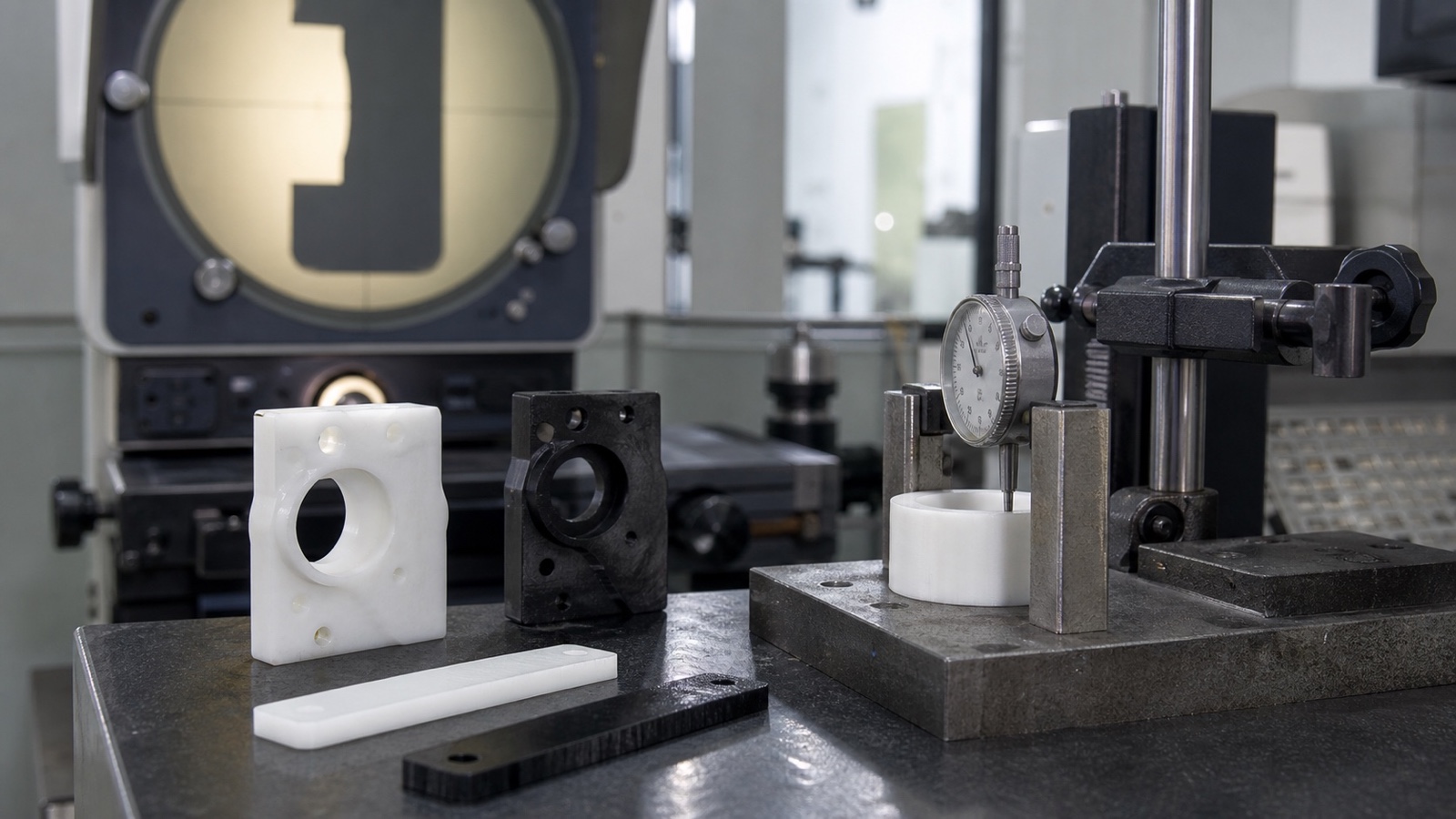
For precision plastic components, thermal performance and moisture response must be considered together with geometry, tolerance, and load.
Chemical Resistance and Environmental Factors
Temperature rarely acts alone. Oils, fuels, cleaners, solvents, UV exposure, hot water, and steam can accelerate property loss or alter the way a polymer responds to heat. We always check chemical-resistance data at the actual operating temperature and concentration.
Resistance to Oils, Fuels, and Industrial Chemicals
POM has strong resistance to many oils, fuels, and solvents, making it useful in numerous mechanical and fluid-handling applications. Nylon’s resistance depends more heavily on the chemical type, concentration, temperature, exposure time, and moisture state of the polymer.
A chemical that is harmless at room temperature may cause swelling, stress cracking, hydrolysis, or accelerated aging at elevated temperature. A resistance chart is a starting point, not a universal approval for every grade or geometry.
Hydrolysis, Hot Water, and Steam Exposure
Hot, wet environments can be especially demanding for nylon. Hydrolysis-resistant nylon grades are available for applications involving heat and moisture, but the grade must be selected for the actual exposure conditions.
Neither POM nor nylon should be assumed suitable for high-temperature steam or aggressive hot chemical exposure without grade-specific validation. Pressure, cycle duration, sterilization method, and mechanical load can all change the result.
UV and Outdoor Heat Exposure
Both POM and nylon may require UV stabilizers, suitable pigments, or protective design features for outdoor use. Black, UV-stabilized grades are common for outdoor components, but color alone does not prove long-term UV performance.
Outdoor parts also experience daily thermal cycling, rain, humidity, and contamination. We consider all of these factors when reviewing material selection for exposed mechanisms or replacement components.
Processing Temperature: Injection Molding and Extrusion Considerations
Processing temperature is not the same as melting point. A polymer must be hot enough to flow and fill a mold or extrusion die, but excessive heat or residence time can degrade it. Processing conditions also affect crystallinity, shrinkage, internal stress, warpage, and final dimensions.
Typical Processing Window for POM
POM has a relatively narrow safe processing window. Excessive residence time, overheating, poor venting, or contamination can cause thermal degradation. Temperature control, proper handling, and process monitoring are important because severe degradation can generate formaldehyde-containing fumes.
For machined POM stock, we still consider heat buildup during cutting. Sharp tooling, suitable feeds and speeds, chip evacuation, and controlled clamping help prevent local melting or distortion.
Typical Processing Window for Nylon
Nylon generally requires higher melt temperatures than POM, particularly PA66. Its processing window is also strongly affected by moisture. If wet resin is processed, hydrolytic degradation can reduce molecular weight and lead to surface defects, reduced mechanical properties, and inconsistent results.
In CNC machining, nylon can be machined successfully, but heat buildup and moisture-conditioned dimensions require more attention than POM. We confirm stock condition and allow the material to stabilize when tight tolerances are required.
Drying Requirements: Nylon vs POM
Nylon requires careful pre-drying because it readily absorbs moisture from the air. Drying temperature, time, storage, and transfer to the molding machine must follow the supplier’s recommendations. Inadequate drying can cause splay, bubbles, reduced molecular weight, and inconsistent mechanical properties.
POM is less moisture-sensitive and normally has less demanding drying requirements, but it should still be stored and processed according to the supplier’s instructions. Surface defects, dimensional variation, and contamination can still affect the finished part.
Mold Temperature, Shrinkage, and Warpage
Both POM and nylon are semi-crystalline and can experience meaningful shrinkage. Mold temperature, wall thickness, cooling rate, fiber reinforcement, gate design, flow direction, and part geometry influence crystallinity and final dimensions.
For CNC-machined parts, the equivalent concerns include stock stress, thermal expansion during cutting, orientation in extruded or molded plate, and stabilization after machining. These factors are important when a buyer requires tight tolerances across a large part or a complex geometry.
Mechanical Properties at Elevated Temperature
Room-temperature tensile strength is not enough to select a polymer for a hot component. We compare retention of tensile strength, modulus, impact resistance, friction behavior, wear, creep, and dimensional stability under the expected combination of temperature, load, moisture, and chemicals.
Strength and Stiffness
Nylon can provide high strength, especially in PA66 and glass-filled grades. However, stiffness may decline with absorbed moisture and elevated temperature. The dry-as-molded value may therefore overstate the performance of a nylon part operating in a humid environment.
POM offers strong stiffness and consistent dimensions across dry-to-humid conditions within its recommended temperature range. For precision mechanisms, that consistency can outweigh nylon’s higher nominal strength.
Wear Resistance and Friction
Both materials are widely used for low-wear components. POM is recognized for low friction and strong dry-running suitability, making it a common choice for bushings, rollers, gears, guides, and sliding components.
Nylon can also be highly wear resistant and impact tolerant, especially in bearing or gear applications where toughness is important. Lubrication, counterface material, pressure, speed, surface finish, and temperature all influence actual wear life.
Load-Bearing Capacity
Nylon, particularly reinforced PA66, often performs better in high-load, high-heat structural applications. Glass fiber can increase stiffness, HDT, and creep resistance, although the resulting material may be more anisotropic and less impact-tolerant.
POM is frequently selected for moderate-load precision mechanisms, sliding components, and parts where dimensional repeatability and low friction are essential. We check bearing pressure, speed, duty cycle, support conditions, and temperature before finalizing the material.
POM vs Nylon Comparison Table for Material Selection
This decision-oriented comparison is a useful screening tool. The actual result depends on the grade, reinforcement, conditioning state, geometry, and operating environment.
| Property | POM (Acetal) | Nylon (PA6/PA66) |
|---|---|---|
| Melting point | Lower than PA6 and PA66 | Higher, especially PA66 |
| High-temperature capability | Moderate | Generally stronger, especially PA66 |
| Moisture absorption | Very low | Moderate to high, depending on grade |
| Dimensional stability in humidity | Excellent | Can change after moisture uptake |
| Low-friction performance | Excellent | Good to excellent by grade |
| Impact resistance | Good | Often better, especially conditioned nylon |
| High-load capability | Good within moderate thermal limits | Strong, especially reinforced grades |
| Drying before molding | Usually less demanding | Critical |
| Precision parts in wet conditions | Often preferred | Requires moisture allowances |
| High-heat structural components | Limited compared with PA66 | Often preferred |
When to Choose POM Instead of Nylon
POM is a strong candidate when the part operates at moderate temperatures and must maintain a precise fit while moving, sliding, rotating, or handling fluid. Its low moisture absorption and low friction are often decisive.
Choose POM for Precision, Low-Friction Parts
We commonly recommend POM for gears, bushings, rollers, clips, latches, valve components, conveyor parts, guides, and fluid-handling components. It is also highly machinable, with predictable chip formation and good dimensional stability.
- Low friction and good dry-running behavior are required.
- Tight tolerances must remain stable through normal humidity changes.
- The application involves moderate temperatures rather than sustained high heat.
Choose POM for Humid or Washdown Environments
POM is often preferable when dimensional stability after water exposure is critical. Examples include appliance mechanisms, plumbing components, food-equipment parts, conveyor components, and outdoor mechanical assemblies, subject to regulatory and chemical requirements.
When to Choose Nylon Instead of POM
Nylon is usually the stronger choice when heat, impact, structural loading, or reinforcement options dominate the design. We pay particular attention to moisture conditioning and the change in properties between the dry and humid states.
Choose Nylon for Higher-Temperature Applications
PA66 or a heat-stabilized nylon is a logical starting point when service temperatures exceed POM’s practical range. Typical examples include automotive under-hood components, electrical housings, fan components, cable-management parts, brackets, and high-temperature mechanical assemblies.
Choose Reinforced Nylon for High Loads and Creep Resistance
Glass-filled nylon is appropriate for brackets, housings, structural parts, and heavily loaded gears that need improved stiffness, HDT, and creep resistance. The tradeoffs include increased warpage risk, fiber-direction effects, abrasive wear on tooling, and potentially reduced impact resistance.
For CNC-machined reinforced nylon, we also consider tool wear, edge quality, fiber exposure, and the effect of material orientation on the final part.
Can Nylon Handle High-Impact Applications?
Yes. Nylon is commonly selected for impact-loaded components because of its toughness, particularly in properly conditioned or impact-modified grades. Actual performance changes with temperature, moisture content, reinforcement level, notch sensitivity, and part geometry.
Cost, Machinability, and Long-Term Value
Material price is only one part of the total cost. Tooling, scrap, drying energy, process controls, machining time, inspection, field performance, maintenance, and replacement frequency can all change the economic result.
Is POM Easier to Machine Than Nylon?
POM is generally regarded as highly machinable because of its dimensional stability, predictable chip formation, and low moisture uptake. It is a practical material for prototypes, low-volume production, replacement parts, and complex precision components.
Nylon can also be machined successfully, but moisture conditioning and heat buildup need greater attention. A nylon part may require more careful stabilization and tolerance planning, particularly when the finished component will operate in a different humidity environment from the machine shop.
Material and Manufacturing Cost Considerations
Commodity PA6 may be cost-competitive, while PA66, heat-stabilized grades, reinforced grades, and specialty POM formulations can cost more. Nylon’s drying, storage, and processing requirements should be included in the manufacturing estimate.
For custom CNC parts, we also consider stock availability, machining time, tool wear, inspection requirements, and whether the selected grade is readily available in the required plate, rod, or tube size.
Long-Term Maintenance and Replacement Costs
The lowest resin price may not produce the lowest lifecycle cost. A POM part may last longer when moisture-driven tolerance changes would cause a nylon mechanism to bind. Conversely, nylon may offer better value in a high-temperature, high-load application where POM would creep or lose stiffness.
We recommend comparing wear life, maintenance intervals, field replacement difficulty, downtime, and expected service life rather than comparing only the initial unit price.
Common Applications: POM vs Nylon
The best material choice becomes clearer when the application’s thermal and environmental demands are stated explicitly.
Automotive and Transportation
POM is used for fuel-system-adjacent precision mechanisms, latches, clips, guides, and interior moving parts where low friction and dimensional stability are useful. Nylon, especially heat-stabilized or reinforced PA66, is commonly considered for under-hood structural and heat-exposed components.
Gears, Bearings, and Wear Components
POM is often preferred for quiet, precise, low-friction gears, bushings, rollers, and wear strips. Nylon may be better for higher-impact, higher-load, or higher-temperature gear systems, especially when a reinforced grade can improve stiffness and creep resistance.
Electrical and Electronics
Nylon is common in connectors, cable ties, housings, brackets, and electrical components requiring toughness and thermal resistance. Flame-retardant and electrical grades require separate evaluation because base-resin melting point does not establish the complete electrical or regulatory performance of the finished part.
Consumer, Appliance, and Industrial Equipment
Both materials appear in pumps, valves, fastening systems, conveyor components, appliance mechanisms, tool parts, machine housings, robotics, fixtures, and jigs. We match the grade to heat, moisture, chemical exposure, friction, wear, structural loading, and tolerance requirements.
Frequently Asked Questions About POM vs Nylon Thermal Performance
Is POM More Heat Resistant Than Nylon?
Generally, no. Standard PA6 and especially PA66 usually have higher melting points and better high-temperature capability than POM. POM may still outperform nylon where humidity-driven dimensional stability and low friction are more important than maximum heat resistance.
Which Has a Higher Melting Point: POM or Nylon?
Nylon has the higher melting point in common comparisons, with PA66 typically highest among widely used nylon grades. PA12 is the key exception because its melting range is closer to POM than to PA6 or PA66.
Can POM Replace Nylon?
POM can replace nylon in certain low-friction, precision, moisture-exposed, moderate-temperature applications. It is not a direct replacement for high-temperature, high-impact, or heavily reinforced nylon applications without engineering review.
Is Nylon or Acetal Better for Gears?
Acetal or POM is often better for precision, low-moisture, low-friction gears. Nylon can be better for high-impact, higher-load, or elevated-temperature gear systems. Evaluate torque, speed, lubrication, backlash tolerance, humidity, and continuous operating temperature.
Which Material Is More Water Resistant?
POM is substantially more water resistant in terms of moisture absorption and dimensional stability. Low-moisture nylons such as PA12 improve water resistance, but they generally do not match POM’s low uptake.
Which Material Is More Cost-Effective Long Term?
POM may offer better lifecycle value for precision parts in humid environments, while nylon may offer better value in high-temperature or high-load applications where POM would deform or lose performance. Compare total cost, not resin price alone.
Final Recommendation: Selecting Between POM and Nylon
Choose POM for moderate-heat, low-friction, precision parts that must retain their dimensions in humid conditions. Choose nylon, especially PA66, heat-stabilized nylon, or glass-filled nylon, for higher temperatures, impacts, structural loads, and applications where improved creep resistance is needed.
Before releasing a drawing or requesting a quotation, we recommend reviewing this checklist:
Continuous operating temperature and peak temperature
Duration and frequency of heat exposure
Mechanical load, impact, creep, and duty cycle
Humidity, water exposure, and conditioning state
Chemical, oil, fuel, cleaner, UV, and steam exposure
Tolerance requirements, reinforcement, and supplier data-sheet validation
Processing capability, inspection needs, and regulatory requirements
At PlasticCNCPro, we manufacture custom POM, nylon, and other engineering polymer parts for prototypes, low-volume production, and repeat manufacturing. We review drawings, CAD files, samples, tolerances, material grades, and application conditions before production so the selected plastic is practical for both performance and manufacturing.
Discuss Your Material Selection
Need a reliable POM or nylon CNC-machined part?
Send us your 2D drawing, 3D model, material requirement, quantity, tolerance, and application details. We can help review heat, moisture, chemical, friction, wear, and manufacturability requirements for your custom plastic component.
Request a quotationPlasticCNCPro inquiry